
Ministry of Water Resources and Irrigation
Biography
Prof. Dr. Hani Sewilam
Minister of Water Resources and Irrigation
Extensive academic and professional experience in hydrology, water resources management, sustainable development, and water governance.
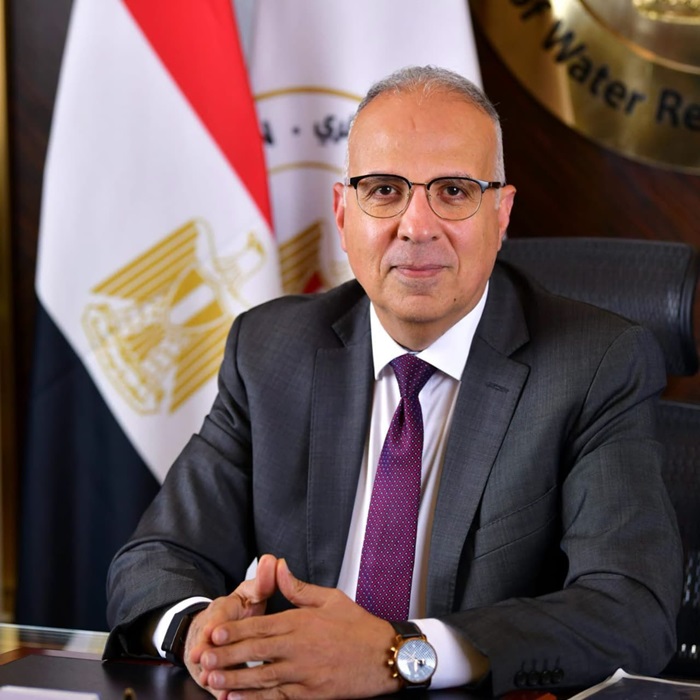
H.E. Prof. Dr. Hani Sewilam is the Egyptian Minister of Water Resources and Irrigation and a professor of Hydrology and Water Resources Management.
Under Minister Sewilam’s leadership, Egypt has embarked on establishing the second generation of irrigation management, marking a transformative shift in the country’s water resource governance strategy. Known as “Irrigation v2.0,” this new phase focuses on integrating advanced technologies, digital transformation, and sustainable practices to enhance water-use efficiency and agricultural productivity.
The approach emphasizes modernizing irrigation systems, promoting precision agriculture, and adopting smart water management solutions to address the challenges posed by climate change, population growth, and limited water resources. It aims to optimize every drop of water through innovation, infrastructure modernization, and strengthened institutional capacity, in alignment with Egypt’s vision for water security and sustainable development.
Prof. Sewilam served as the Managing Director of the UNESCO Chair in Hydrological Changes and Water Resources Management at RWTH Aachen University in Germany. He also served as the Rector’s Delegate for African Countries and as Academic Director of the Department of Engineering Hydrology.
In Egypt, he was a professor at the American University in Cairo and the founding director of the Center for Applied Research in Environmental Sustainability (CARES), a center dedicated to sustainable development. He also co-founded an MSc program in Sustainable Management – Water and Energy at RWTH Aachen University and established an MSc program in Sustainable Development at the American University in Cairo.
Prof. Sewilam began his professional career as a researcher at the National Water Research Center of the Ministry of Water Resources and Irrigation in Egypt. Since 2002, he has secured funding and implemented numerous international research and development projects in collaboration with institutions from more than 20 European, Mediterranean, and African countries.
His work has covered flood risk management, solar-powered desalination, aquaponics, hydroponics, water scarcity, rainwater harvesting, effective water management, and innovative capacity-building programs for water professionals.
His main areas of expertise include hydrology, water management, desalination, integrated water systems, and the Water–Energy–Food nexus. His research has also explored the relationship between the nexus and the achievement of the Sustainable Development Goals (SDGs).
Between 2018 and 2021, Prof. Sewilam was part of the core technical team supporting negotiations among Egypt, Sudan, and Ethiopia on the Grand Ethiopian Renaissance Dam. He has authored more than 130 international publications in water-related fields and contributed to establishing several long-term initiatives.
Prof. Sewilam earned his PhD, summa cum laude, in Water Resources Management from RWTH Aachen University, his MSc in Irrigation and Environmental Engineering from the University of Southampton, and his BSc in Irrigation and Environmental Engineering from Zagazig University.
In 2022, he received the Water–Energy–Food–Ecosystem (WEFE) Nexus Award from PRIMA, part of the European Union. His course “Water–Energy–Food Nexus and Sustainable Development” was also selected for global delivery through edX as a Massive Open Online Course (MOOC).
Academic Journey
Academic Qualifications
1986 – 1991
Zagazig University
1991
Environmental and Irrigation Engineering
Zagazig University
1992 – 1994
University of Southampton
1998 – 2002
RWTH Aachen University
Selected Initiatives & Regional Roles
Cairo Water Week
COP27 – 2022
UN Water Conference 2023
AMCOW
Pan Africa Center for Water Adaptation
Arab Ministerial Water Council
African Water Facility
CARES
MOOC
Professional Experience
1991–1997
Researcher – National Water Research Center
Ministry of Water Resources and Irrigation, Egypt
Managed research stations and participated in national and international irrigation and water management projects.
1998–2002
Research Assistant – Department of Engineering Hydrology
RWTH Aachen University, Germany
Conducted PhD research and contributed to hydrology and water resources management projects.
2002–2009
Deputy Director – Department of Engineering Hydrology
RWTH Aachen University
Led academic teams, coordinated projects, and supervised postgraduate programs.
2009–2011
Senior Officer – Capacity Development Program
UN-Water Decade Programme – UNW-DPC
Coordinated water capacity development activities with more than 20 UN agencies and international organizations.
2009–2022
Managing Director – UNESCO Chair
Hydrological Changes and Water Resources Management
Led international research initiatives addressing hydrological challenges and sustainable water management across the MENA region.
2011–2017
Professor of Water Resources Management and Sustainable Development
The American University in Cairo
Taught and conducted research in sustainable water management, the Water–Energy–Food nexus, and desalination for irrigated agriculture.
2011–2022
Academic Director – Department of Engineering Hydrology
RWTH Aachen University
Coordinated academic, research, and administrative activities, including teaching, fundraising, water management research, and flood risk management.
Ministerial Leadership
Minister of Water Resources and Irrigation
Arab Republic of Egypt
Leading Egypt’s water resources and irrigation management system and advancing the second generation of irrigation management and comprehensive water governance.
Ministry Portfolio
Second-Generation Irrigation Management and Comprehensive Water Governance in Egypt
Policies & Strategies
- Developing national policies and regulations for sustainable water management, including the executive regulations of Water Resources Law No. 147 of 2021.
- Updating the National Water Resources Strategy through 2050, integrating climate change considerations and monitoring frameworks.
Water Allocation & Flood Management
- Supervising fair and efficient water distribution across approximately 55,000 km of water channels.
- Managing strategic infrastructure, including the High Aswan Dam and major barrages.
- Planning water requirements for approximately 4 million acres of newly reclaimed land.
Infrastructure Projects
- Overseeing coastal protection works along approximately 2,000 km of coastline.
- Maintaining more than 1,500 flood protection structures.
- Implementing the National Water Structures Rehabilitation Project covering approximately 4,000 structures.
- Implementing irrigation and drainage projects serving approximately 9 million acres.
Non-Conventional Water Resources
- Enhancing water treatment and reuse through major projects such as Bahr El Baqar and the New Delta.
- Expanding rainwater harvesting initiatives.
- Advancing desalination solutions for agricultural applications.
Water Quality & Environment
- Applying pollution control regulations to protect the Nile River and waterways.
- Updating water-use regulations and preventing encroachments to safeguard aquatic environments.
Regional & International Cooperation
- Representing Egypt and leading national delegations in international water-related forums.
- Strengthening international partnerships in water research, innovation, and technology.
Research, Innovation & Digital Transformation
- Advancing digital transformation through GIS, remote sensing, and drone technologies.
- Linking scientific research priorities with practical water-sector needs.
- Supporting the research agenda of the National Water Research Center.
Human Resources & Community Engagement
- Supporting capacity development for water-sector professionals.
- Developing programs to prepare future water-sector leaders.
- Raising farmers’ awareness and supporting Water User Associations.
Sectoral Coordination & Asset Management
- Coordinating with other ministries to align water policies with sectoral strategies.
- Strengthening cooperation with governorates to maximize the use of Ministry assets.
Technical Inspection & Monitoring
- Regulating water uses and addressing violations through technical and legal oversight.
- Ensuring effective maintenance of canals and drains through technical supervision.
Memberships & Affiliations
Managing Director, UNESCO Chair in Hydrological Changes and Water Resources Management.
Member, Partnership for Research and Innovation in the Mediterranean Area (PRIMA).
Awards & Recognition
WEFE Nexus Award
Water–Energy–Food–Ecosystem (WEFE) Nexus Award, awarded by PRIMA, part of the European Union – 2022.
Publications & Research
Books – Book Chapters – Peer-Reviewed Journal Papers
- Sewilam, H. et al. Teaching and Learning Kits for Sustainable Development, Level 1. Adam Publishing House, 2014. Registration number: 22587/2013, ISBN: 978-977-8505-82-5.
- Sewilam, H. et al. Teaching and Learning Kits for Sustainable Development, Level 2. Adam Publishing House, 2014. Registration number: 22588/2013, ISBN: 9789778505832.
- Sewilam, H. et al. Teaching and Learning Kits for Sustainable Development, Level 3. Adam Publishing House, 2014. Registration number: 22589/2013, ISBN: 978-977-8505-84-9.
- Sewilam, H. et al. Teachers Guide – Education for Sustainable Development. Adam Publishing House, 2014. Registration number: 22611/2013, ISBN: 9789778505894.
- Sewilam, H. and Rudolph, K. Editors. Capacity Development for Drinking Water Loss Reduction: Challenges and Experiences. August Dreesbach Verlag, 2011. ISBN 978-3-940061-51-5.
- Nacken, H., Bartusseck, S., Sewilam, H. Editors. Entscheidungsunterstützung in der Wasserwirtschaft – von der Theorie zum Anwendungsfall. Aachen: GFZ, 2005.
- Sewilam, H. Neuro-Fuzzy Modelling for Conflict Resolution in Irrigation Management. Aachen, Germany: Shaker Publisher GmbH, 2004. ISBN 3-8322-3369-5. PhD dissertation published as a book.
- Sewilam and Nasr. “Desalinated Water for Food Production in the Arab Region,” in The Water, Energy, and Food Security Nexus in the Arab Region. Springer, Cham.
- Marlene, M., Sewilam, H., Mader, C. “EduCamp – Bildung für nachhaltige Entwicklung in Ägypten,” in Bildung für Nachhaltige Entwicklung, 2015, pp. 139–145.
- Sewilam, H. “RCE Cairo: The EduCamp Project – A Multi-Level Cooperation of RCEs,” in Towards More Sustainable Consumption and Production Systems and Sustainable Livelihoods, UNU-IAS, 2012.
- Sewilam, H. and Liebe, J. “Capacity Development for Safe Use of Wastewater in Agriculture,” in Water and the Green Economy, UNW-DPC, Bonn, Germany, 2012.
- Sewilam, H. and Alearts, G. “Knowledge and Capacity Development,” in The United Nations World Water Development Report 4: Managing Water under Uncertainty and Risk, UNESCO, 2012.
- Sewilam, H. “Capacity Development for Water Loss Reduction,” in Capacity Development for Drinking Water Loss Reduction: Challenges and Experiences, August Dreesbach Verlag, 2011.
- Sewilam, H. “Rule-Based Systems for Ecohydrological and Morphological Decision Making,” in Decision Support Systems, In-TECH Publisher, 2009.
- Sewilam, H., Breuer, H., Nacken, H., Pyke, C. “Competence-Based and Game-Based Capacity Development for Sustainable Water Management in Germany,” Journal of Environmental Earth Sciences, 76(3), 2017.
- El Barmelgy, A., Nasr, P. and Sewilam, H. “Sustainable Approaches for Utilizing Desalination Reject Brine,” International Journal on the Science and Technology of Desalting and Water Purification.
- El-Essawy, H., Nasr, P., and Sewilam, H. “Aquaponics as a Sustainable Alternative to New Land Reclamation and Conventional Agriculture in Egypt,” Journal of Clean Technologies and Environmental Policy.
- Albadry, S., Tarabiah, K., and Sewilam, H. “Achieving Net Zero-Energy Buildings through Retrofitting Existing Residential Buildings Using PV Panels,” Energy Procedia 115, 195–204, 2017.
- Breuer, R., Sewilam, H., Pyke, C. and Nacken, H. “Exploring the Application of a Flood Risk Management Serious Game Platform,” Journal of Environmental Earth Sciences, 76(2), 2017.
- Nasr, P. and Sewilam, H. “Selection of Potential Fertilizer Draw Solution for Fertilizer Drawn Forward Osmosis Application in Egypt,” Desalination and Water Treatment, 65, 22–30, 2017.
- Pyka, C. et al. “Effects of Water Diversion and Climate Change on the Rur and Meuse in Low-Flow Situations,” Journal of Environmental Earth Sciences, 75, 1206, 2016.
- Nasr, P. and Sewilam, H. “Investigating Fertilizer Drawn Forward Osmosis Process for Groundwater Desalination for Irrigation in Egypt,” Desalination and Water Treatment, 57(56), 26932–26942, 2016.
- Nasr, P. and Sewilam, H. “Investigating the Performance of Ammonium Sulphate Draw Solution in Fertilizer Drawn Forward Osmosis Process,” Journal of Clean Technologies and Environmental Policy, 18, 717–727, 2016.
- Nasr, P. and Sewilam, H. “Forward Osmosis: An Alternative Sustainable Technology and Potential Applications in Water Industry,” Journal of Clean Technologies and Environmental Policy, 17(7), 2079–2090, 2015.
- Nasr, P. and Sewilam, H. “The Potential of Groundwater Desalination Using Forward Osmosis for Irrigation in Egypt,” Journal of Clean Technologies and Environmental Policy, 17(7), 1883–1895, 2015.
- Sewilam, H., McCormack, O., Mader, M. et al. “Introducing Education for Sustainable Development into Egyptian Schools,” Environment, Development and Sustainability, 17(2), 221–238, 2015.
- Sewilam, H. et al. “Rule-Based Decision Support System for the Morphological Rehabilitation of Watercourses,” International Journal of Water Resources Management, 21, 2037, 2007.
- Breuer, R., Sewilam, H., Nacken, H. “SeCom2.0 – Teaching and Learning in Flood Risk Management by Means of Serious Games,” Hydrologie und Wasserbewirtschaftung, 59(1), 2015.